State Roadkill Information

The utilization of roadkill for consumption or artistic purposes is subject to state-specific laws and regulations. Each state's Department of Natural Resources establishes these guidelines, which vary based on factors such as local weather conditions, animal populations, and species. Specific animal parts may be restricted from use in art, and proper disposal of carcasses is universally mandated. The Roadkill Art App provides comprehensive access to all state-required roadkill laws and regulations.
Idaho Law Permits Selling Roadkill Art
Idaho Roadkill Laws for Animal Art
In Idaho you can purchase or sell wildlife parts, but not the meat of big game, upland game, up birds or furbearer's that are lawfully hunted or trapped that have been killed in vehicle-collisions. Bighorn sheep can't be purchased, bartered, or sold. The Idaho animal artist or taxidermist when finding roadkill can consume the meat but never sell the meat. The fur and bones can be used for art and legally sold in Idaho. In Idaho, if someone legally salvages a roadkilled deer for taxidermy, the remaining carcass must be disposed of in a lawful sanitary manner once the usable parts are removed. Contact the Idaho Department of Fish and Game.

Rhode Islands New Roadkill Salvage Program

Rhode Island Finds Value in Roadkill
Rhode Island accepting roadkill for sustainability has a new roadkill salvage program already issuing 100 salvage permits. Eligible species include white-tailed deer, turkeys, beavers, coyotes, muskrats, pheasants, squirrels, rabbits, and raccoons. Permits ae free and must be obtained within 24 hours of collecting the wildlife. https://www.facebook.com/RIFishwildlife
California Hunter's can Possess a Jack Rabbit
California law makes the Jack Rabbit Roadkill Illegal
It is illegal to collect, possess, or transport roadkill jackrabbits in California, making their use for taxidermy unlawful. California law currently prohibits the collection and possession of dead wildlife, including roadkill, without specific authorization. To legally have a jackrabbit taxidermied in California, the animal must be taken legally during its open season and possession limits, as there are no bag limits for jackrabbits. The taxidermist must maintain records for one year, including the owner's information and details of the specimen, and must also be able to produce the specimen for inspection by law enforcement. Legal take for CA: The jackrabbit must be taken legally. In California, jackrabbits can be taken year-round with no bag or possession limits. In CA it's legal to hunt a jack rabbit and mount it, it's illegal to pick up jack rabbit roadkill and mount it.


Guide to US State Roadkill Laws
This comprehensive guide compiles roadkill regulations and laws for all 50 US states, providing essential information for anyone interested in legally retrieving roadkill. Its vital to know regulations before taking possession of roadkill. Roadkill Art prepared the resource to help app Members legally utilize roadkill.
Rhode Islands Salvage Policy

Rhode Island has no Limit how much Roadkill can be taken by an Individual Annually.
The Rhode Island roadkill salvage policy, governed by the Department of Environmental Management (DEM), actually allows for the salvage of 14 specific species. There is no annual limit on the number of animals a person can salvage, a free permit is required for each individual animal collected.
The policy, which went into effect on March 25, 2025, requires the public to obtain a Wildlife Roadkill Salvage (WRS) Permit within 24 hours of collecting an animal killed in a vehicle collision. Reporting can be done online or by phone (401-789-0281) 14 Eligible Species: White-tailed deer, Wild turkey, Pheasant, Coyote, Red Fox, Gray Fox, Rabbit, Beaver, Squirrel, Muskrat, Raccoon, Fisher, Woodchuck and
Mute Swan.
Meat from roadkill must be used for consumption (human or pet) and cannot be sold or donated to retail facilities. https://dnr.wisconsin.gov
Who can take roadkill in Alaska?
The Alaska new Roadkill Salvage Program allows eligible organizations and groups to salvage animals from a roadkill incident in their areas after being notified by Troopers or other law enforcement agencies. Registered participants must respond within 30 minutes of notification and remove the entire animal from the roadway, then the participant can process the animal for consumption. Alaska salvage teams and nonprofits can register at: https://dps.alaska.gov/AWT/Roadkill.
Requested information can submitted online, participants will be quickly notified if a salvageable animal is available in their area. Every year hundreds of moose and other animals are unfortunately killed on Alaska’s roadways; with the new Roadkill Salvage Program, Alaska will help supply meat to Alaskan Soup Kitchens. Previously Alaskan law required all roadkill go to soup kitchens, the roadkill door is now opened to all Alaskan citizens.
Wisconsin DNR Works with Public Input Managing Deer

The Wisconsin Department of Natural Resources invites public input for deer management. Each Deer Management Unit, (hunting areas) has a Citizen Deer Advisory Council, to provide recommendations.
Recommendations are based on deer herd metrics, management goals and public feedback.This process is done annually to allow for adjustments to the previous year’s deer harvest, winter severity and other factors. Councils in the Northern and Central Forest Deer Management zones will make recommendations for new habitat-based management units. Boundaries in the Northern Forest Zone were changed from county lines to habitat-based units. Modifications have also been made to metro subunits in the southeaste.
Map of the deer units. https://dnr.wisconsin.gov/
Nebraska Landfill disposal is a legal option in urban areas
To properly dispose of a deer carcass in Omaha, one must follow the regulations per the Nebraska Revised Statute 54-2946. Nebraskans commonly see remains of deer on the roads. For Omaha/Nebraska-specific disposal guidance, the most relevant authorities would be: Local Omaha public works or solid waste departments, Nebraska Game and Parks Commission or Nebraska Department of Environment and Energy.
Lee Emma Running an independent artist has turned roadkill into master pieces, creating fascinating sculptures with roadkill bones and skins. Using ribs and other deer bones carefully polished. Running says she has sufficient skeletons to choose from; finding bones on the side of roads. She sterilizes the bones through heat and peroxide, and the art begins. The sculpture pictured is titled: Acts of Transformation. This entire white-tail deer hide is stretched over a handmade paper cast of Running's body. From inside the flayed chest of the hide, an 8-foot sheet of lacy handmade paper pulp gilded with white gold cascades hangs to the floor.
Do Your State Roads Produce Black Bear Roadkill?
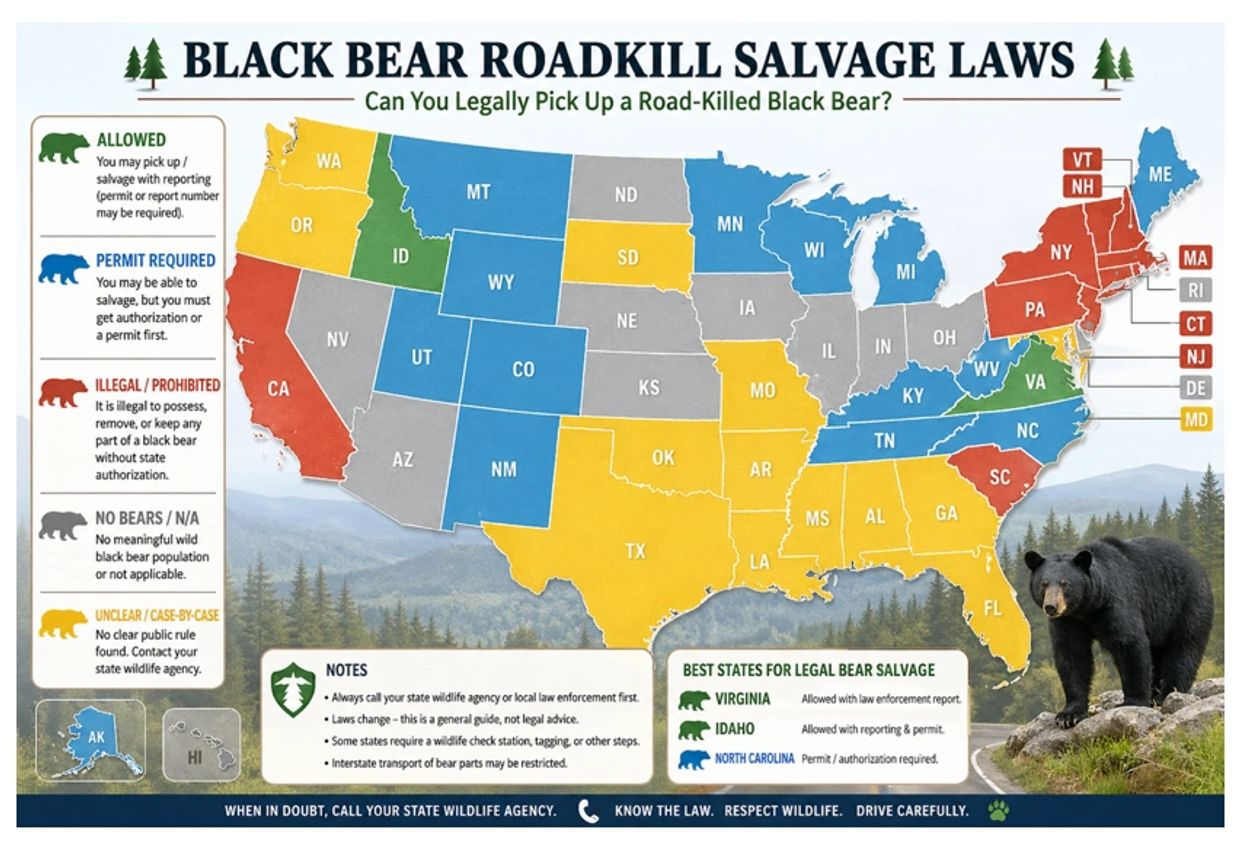
Do You Know Your States Legality for Taking Black Bear Roadkill?
Few states allow public pickup of a road-killed black bear, and only with reporting, a permit, or law-enforcement authorization. Bears are managed big-game species, so they’re treated more strictly than deer. Check the map for your states Black Bear Roadkill Laws.
Black Bear in New Hampshire
Why Black Bears Seldom Become Roadkill in Conway, NH
The New Hampshire Fish and Game Department reminds residents and visitors that black bears are wild and should be treated as unpredictable, even though fatal bear encounters are rare. Black bears are omnivores. Their diet consists primarily of nuts, berries, fruit, plants, and insects. They may also scavenge prey killed by other wildlife. Black bears thrive in New Hampshire’s White Mountain National Forest, which contains some of the state’s highest bear densities. The bear pictured was photographed in the yard of a home in Conway, New Hampshire, near the National Forest. Extending across more than 800,000 acres in New Hampshire and Maine, the National Forest contains rugged mountains, hardwood forests, rivers, streams and wetlands. It is one of only two national forests in New England and includes 160 miles of the Appalachian Trail. The forest protects 35 watersheds, 4,000 miles of streams, and 12,000 acres of wetlands. This enormous protected habitat gives black bears room to find food, water, shelter, and natural travel corridors away from heavily developed areas.
Conway’s small human population and proximity to a vast protected forest reduces their exposure to traffic. Their natural caution may also help explain why bears appear to become roadkill less frequently than deer and other large species in the area.
Put Out Water in Wyoming

Spike in Roadkill in Wyoming
Wyoming wildlife is being drawn to greenery and water alongside highways. “Wildlife biologists from the Wyoming Game and Fish Department are reporting a surge in big game animals clustering along highways and rights-of-way, in search for food and water. Out of respect for wildlife we utilize roadkill and teach about its value. We also do what it takes to prevent roadkill. Reports in the Roadkill Art app help establish animal crossings for animal passovers. Wyoming protect your wildlife from becoming a roadkill report, put out buckets of water not only in summer but also winter.
There are 144 Wildlife Overpasses in the US
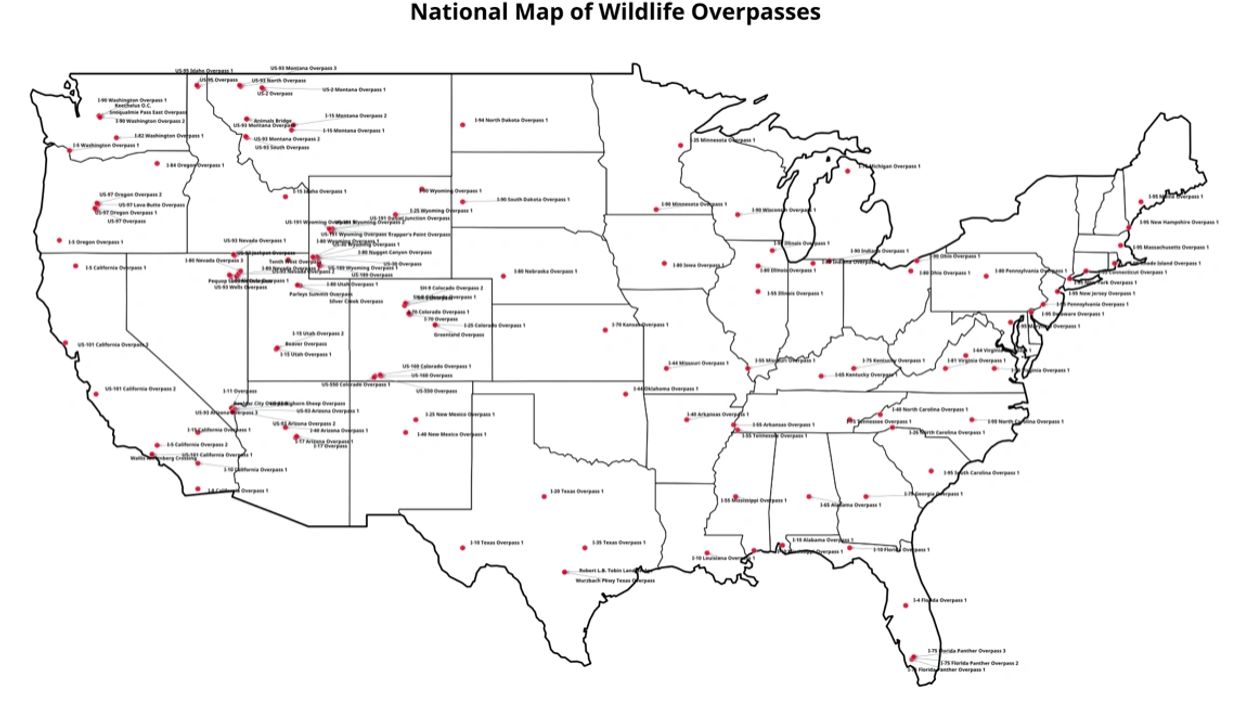
Each Overpass Location Represents High Big Game Populations
There are 144 wildlife overpasses throughout the United States, with a significant concentration in the Western states. These structures, often called "green bridges" or "ecoducts," are designed to provide safe passage for animals across busy highways, effectively reconnecting fragmented habitats and reducing dangerous wildlife-vehicle collisions. The first dedicated wildlife overpass was constructed near Beaver, Utah, on Interstate 15 in 1975. Overpasses allow for the continued migration and genetic exchange of species like mule deer, elk and moose. Check the overpasses in your state, are more needed? Roadkill Art App member's should frequently check the overpass locations and report roadkill.
Increases in Deer Movement Twice a Year
Roadkill Increases in May & June due to Doe Movement
High roadkill season, the rut, starts in September continuing through December in most US states. Roadkill slows down after this time, but increases in spring due to does in movement looking for a place to give birth. A white-tailed deers gestation period is seven months, many fawn are born late spring, May and June.
Reporting live deer sitings in the Roadkill Art App helps avoid a roadkill incident with pregnant doe and young fawn. Deer frequent and cross roads in same locations. Reporting live animals in the app is the same process as reporting roadkill. When rating choose, "Its NOT roadkill he is alive near the road, be careful not to hit him." By marking animal crossing locations, it helps keep pregnant does and fawn safe. May and June are highs for collisions, deer in May and elk in June.
